How Long Should a Nap Be? 10, 20 or 90 Minutes, Compared
For most people, the best nap is 10 to 20 minutes of sleep. In a well-known sleep laboratory study, a 10-minute nap improved alertness and performance immediately, and the benefit lasted about 2.5 hours. Longer naps of 30 to 60 minutes often leave you groggy at first, while a full 90-minute nap lets you complete a whole sleep cycle.
Key facts
- A 10-minute nap gave immediate benefits that lasted up to 155 minutes in a 2006 study.
- A 20-minute nap helped too, but the benefits took about 35 minutes to appear.
- A 30-minute nap caused a period of grogginess (sleep inertia) before it helped.
- NASA found that pilots who napped for about 26 minutes during long flights were up to 54% more alert.
The nap study
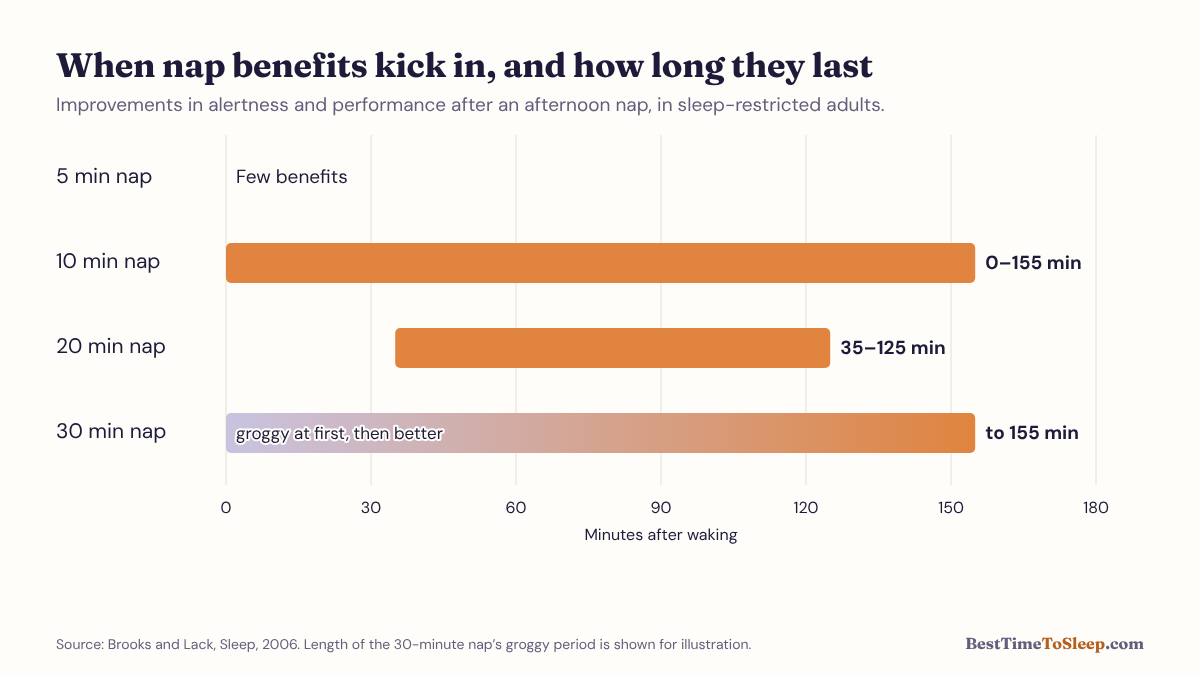
In 2006, Amber Brooks and Leon Lack at Flinders University in Australia compared afternoon naps of 5, 10, 20 and 30 minutes with no nap at all. Their volunteers had their sleep cut short the night before, then took a nap in the lab and were tested on alertness and mental performance for nearly three hours afterwards.
| Nap length | What happened |
|---|---|
| 5 minutes | Few benefits compared with no nap. |
| 10 minutes | Immediate improvements in all measures, lasting up to 155 minutes. |
| 20 minutes | Improvements emerged about 35 minutes after waking and lasted up to 125 minutes. |
| 30 minutes | A period of reduced alertness and performance straight after waking, then improvements lasting up to 155 minutes. |
The authors concluded that the 10-minute nap was the most effective overall: it was long enough to help, but short enough to avoid deep sleep and the grogginess that follows.
Why longer naps can make you feel worse
After roughly 20 to 30 minutes of sleep, you’re likely to be heading into deep sleep. Waking from deep sleep causes sleep inertia: a groggy, slow feeling that can last 30 minutes or more. That’s why a one-hour nap often leaves people feeling worse at first than they did before.
A nap of around 90 minutes avoids this problem in a different way: you go through a full sleep cycle and wake from lighter sleep. It can be useful if you’re very short on sleep or about to work a night shift, but a long nap late in the day can make it harder to fall asleep at night.
The NASA nap
In a 1995 study for NASA, long-haul pilots were given a 40-minute chance to nap in their seat during flights while colleagues flew the plane. On average they slept for 26 minutes. Compared with pilots who didn’t nap, they were up to 54% more alert and their performance was up to 34% better, and they had fewer lapses of attention late in the flight.
When to nap
- Early afternoon is best for most people: about 1 PM to 3 PM, when the body clock causes a natural dip in alertness.
- Avoid napping late, within about 6 to 7 hours of bedtime, if you have trouble falling asleep at night.
- Set an alarm for the length of nap you want plus the time it takes you to fall asleep. Our nap calculator does the maths.
Who shouldn’t nap?
If you have insomnia, daytime naps can make it harder to sleep at night, and the NHS advises people with insomnia to avoid them. If you need a nap every day despite sleeping 7 to 9 hours at night, mention it to a doctor, as it can be a sign of a sleep disorder.
Sources
- Brooks A, Lack L. A brief afternoon nap following nocturnal sleep restriction: which nap duration is most recuperative? Sleep, 2006
- Rosekind MR et al. Alertness management: strategic naps in operational settings. Journal of Sleep Research, 1995
- NHS: Insomnia
Frequently asked questions
Is a 20-minute nap better than a 10-minute nap?
Both help. In the 2006 study, the 10-minute nap worked faster, while the 20-minute nap took about 35 minutes to show its benefits.
Why do I wake up from a nap feeling worse?
You probably woke during deep sleep. Keep naps under about 20 minutes, or sleep a full 90-minute cycle.
Does a nap count towards my sleep?
It counts towards your total sleep in 24 hours, but it doesn’t replace a full night. Use naps to top up, not as a substitute.