How Long Does Caffeine Stay in Your System? (And When to Stop Before Bed)
Caffeine has a half-life of about 5 hours in healthy adults, meaning your body clears half of it in that time. So if you drink a 95 mg cup of coffee at 3 PM, roughly 48 mg is still in your body at 8 PM and 24 mg at 1 AM. A sleep study found that caffeine taken 6 hours before bed still reduced sleep by more than an hour.
Key facts
- Caffeine’s half-life averages about 5 hours, but ranges from about 2 to 10 hours between people.
- 400 mg of caffeine taken 6 hours before bed reduced total sleep by more than an hour, even though people didn’t notice.
- The FDA says up to 400 mg a day is generally not linked to harmful effects for healthy adults.
- To protect your sleep, stop caffeine at least 6 hours before bed, earlier for strong drinks.
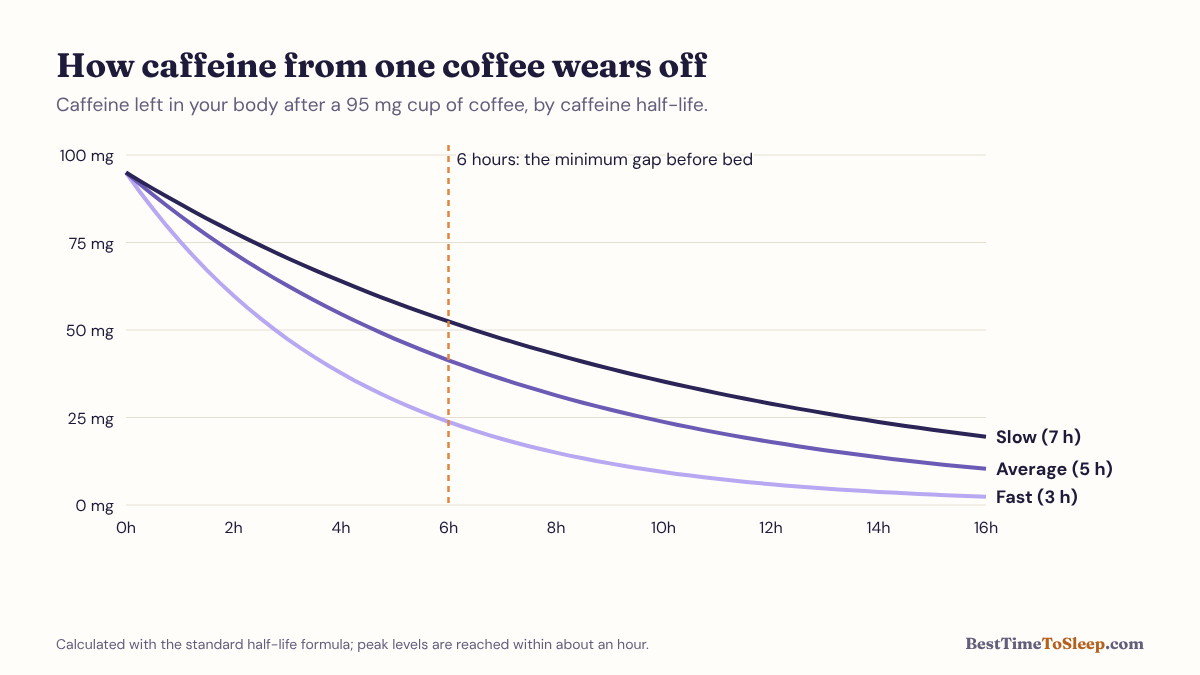
How caffeine wears off
Caffeine works by blocking adenosine, a chemical that builds up in your brain the longer you are awake and makes you feel sleepy. Your liver breaks caffeine down at a fairly steady rate, so the amount in your body halves every few hours.
| Time after a 95 mg coffee | Fast (3 h half-life) | Average (5 h) | Slow (7 h) |
|---|---|---|---|
| 1 hour | 75 mg | 83 mg | 86 mg |
| 3 hours | 48 mg | 63 mg | 71 mg |
| 6 hours | 24 mg | 41 mg | 52 mg |
| 9 hours | 12 mg | 27 mg | 39 mg |
| 12 hours | 6 mg | 18 mg | 29 mg |
Calculated using the standard half-life formula. Peak levels are usually reached within an hour of drinking.
Why people react so differently
Half-life varies a lot. It tends to be longer:
- during pregnancy, especially later in pregnancy
- in people taking oral contraceptives and some other medicines
- in people with liver disease
- with certain gene variants that slow down caffeine breakdown
It tends to be shorter in people who smoke. That’s why one person can drink espresso after dinner and sleep well, while another is kept awake by a mid-afternoon tea.
The 6-hour study
In 2013, Christopher Drake and colleagues at Henry Ford Hospital’s Sleep Disorders Center gave healthy adults a 400 mg caffeine pill (about the amount in 2 to 3 large coffees) at bedtime, 3 hours before bed or 6 hours before bed, and a placebo on other nights. Sleep was measured at home with a monitor.
Caffeine at all three times disrupted sleep. Even at 6 hours before bed, it cut total sleep time by more than an hour. Participants didn’t report sleeping much worse, which suggests people often don’t realise how much late caffeine affects them. The authors suggested avoiding substantial caffeine after about 5 PM.
How much caffeine is in your drink?
| Drink | Typical caffeine |
|---|---|
| Brewed coffee, 8 oz (240 ml) | 80–100 mg |
| Espresso, single shot | about 64 mg |
| Large coffee-shop coffee, 16 oz | about 190 mg or more |
| Black tea, 8 oz | about 47 mg |
| Green tea, 8 oz | about 28 mg |
| Energy drink, 8.4 oz (250 ml) | about 80 mg |
| Cola, 12 oz can | 30–40 mg |
| Decaf coffee, 8 oz | 2–15 mg |
Amounts vary widely by brand and how the drink is made.
What time should you stop?
A simple rule is no caffeine within 6 hours of bedtime. For a 10:30 PM bedtime, that’s 4:30 PM. For a large coffee or an energy drink, or if you are sensitive to caffeine, make it earlier, around noon to 2 PM.
Our caffeine cut-off calculator works out the latest time for your drink and bedtime, and shows how much will still be in your system when you go to bed.
Sources
- Drake C et al. Caffeine effects on sleep taken 0, 3, or 6 hours before going to bed. Journal of Clinical Sleep Medicine, 2013
- US Food and Drug Administration: Spilling the beans: how much caffeine is too much?
- National Institute of Neurological Disorders and Stroke: Brain basics: understanding sleep
Frequently asked questions
How long does it take for caffeine to wear off?
The noticeable effects usually fade within 3 to 5 hours, but caffeine stays in your body much longer. It takes about 25 hours to clear 97% of it at an average half-life.
Can I drink coffee at 4 PM?
If you go to bed at 10 PM or later and aren’t sensitive to caffeine, a single regular coffee at 4 PM is borderline. Earlier is safer.
Does caffeine affect deep sleep?
Studies suggest caffeine can reduce deep, slow-wave sleep and make sleep lighter, even if you fall asleep normally.