What Is the Best Time to Go to Bed? What a Study of 88,000 People Found
The best time to go to bed is one that gives you enough sleep before you have to get up, and that you can keep most nights. If you want a specific time, one large study points to between 10 PM and 11 PM: in a UK study of 88,026 adults, people who fell asleep then had the lowest rate of heart disease over the following six years.
Key facts
- In the UK Biobank study, a sleep onset between 10 and 10:59 PM was linked to the lowest heart disease risk.
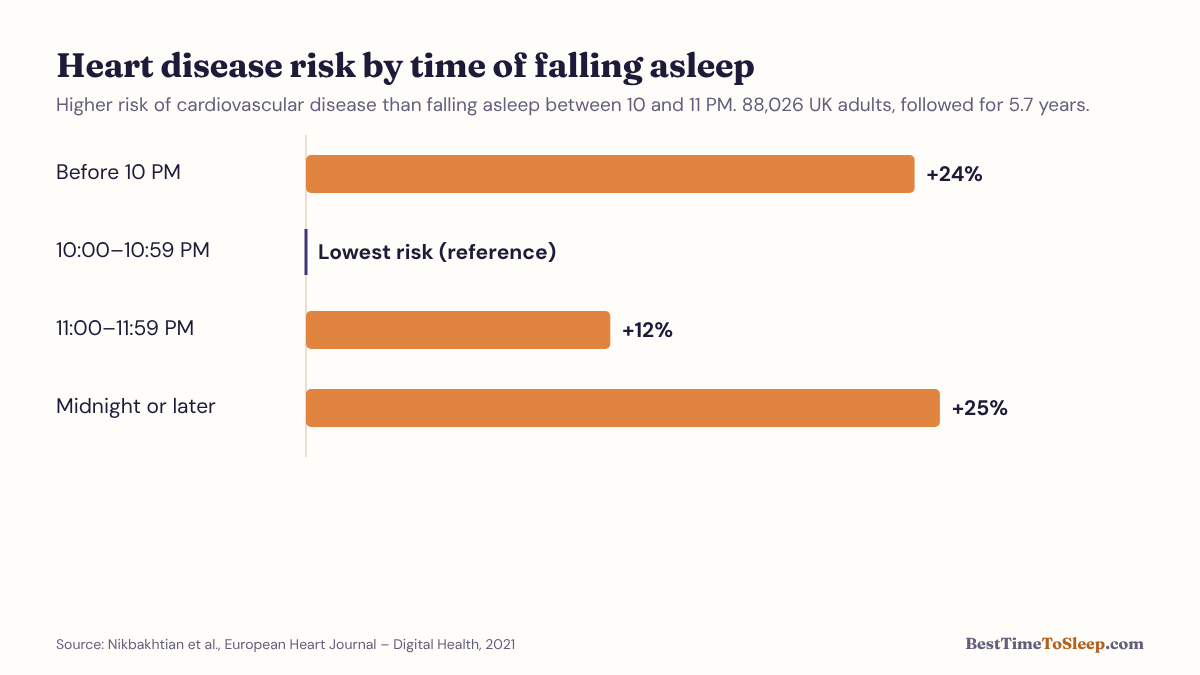
- Falling asleep at midnight or later was linked to a 25% higher risk, and before 10 PM to a 24% higher risk.
- The study shows a link, not proof that bedtime causes heart disease.
- For most adults, the right bedtime is about 7.5 to 9 hours before your alarm.
What the study found
Researchers used data from the UK Biobank, a long-running health study. Participants aged 43 to 79 wore a wrist sensor for seven days, which recorded when they actually fell asleep and woke up, rather than relying on what they remembered. The team then followed them for an average of 5.7 years to see who developed cardiovascular disease, such as a heart attack, heart failure or stroke.
| Time falling asleep | Risk compared with 10:00–10:59 PM |
|---|---|
| Before 10 PM | 24% higher |
| 10:00–10:59 PM | Lowest (reference) |
| 11:00–11:59 PM | 12% higher |
| Midnight or later | 25% higher |
The results took account of age, sex, sleep duration, sleep irregularity, smoking, body weight, blood pressure and other factors. The link was stronger in women; in men, only falling asleep before 10 PM remained significant.
Why might bedtime matter?
The authors’ explanation is the body clock. Your circadian rhythm is set mainly by light, and especially by morning light. Going to sleep very late, or very early, may mean you see light at the wrong time of day, which could shift your body clock out of step with your daily routine. A misaligned body clock has been linked to higher blood pressure and other cardiovascular risks.
Important caveats
- It doesn’t prove cause and effect. People who go to bed late may differ in other ways, such as their work or health, that the study couldn’t fully measure.
- Participants were middle-aged and older, and mostly white British. The results may not apply to younger people.
- Sleep was measured for just one week, and habits can change over the years.
The authors themselves said the findings need to be confirmed in other studies.
So what time should you go to bed?
Start from when you need to get up. Most adults need at least 7 hours of sleep, and it takes most people 10 to 20 minutes to fall asleep. Here are bedtimes for common alarm times that give you 5 full sleep cycles (7.5 hours):
| Wake up at | Go to bed at (7.5 h) | Go to bed at (9 h) |
|---|---|---|
| 5:30 AM | 9:45 PM | 8:15 PM |
| 6:00 AM | 10:15 PM | 8:45 PM |
| 6:30 AM | 10:45 PM | 9:15 PM |
| 7:00 AM | 11:15 PM | 9:45 PM |
| 7:30 AM | 11:45 PM | 10:15 PM |
Times include 15 minutes to fall asleep. Use the sleep calculator for any other time, or browse bedtimes for every wake-up time.
Notice that for a 6 to 7 AM alarm, a bedtime between about 10 and 11:15 PM gives you enough sleep, which lines up neatly with the study’s findings.
Consistency matters as much as the time
Going to bed and getting up at the same time every day helps keep your body clock steady. The American Academy of Sleep Medicine advises getting up at the same time every day, including weekends. Shifting your sleep by several hours at the weekend has a similar effect on your body to flying across time zones, which is sometimes called “social jet lag”.
Sources
- Nikbakhtian S et al. Accelerometer-derived sleep onset timing and cardiovascular disease incidence: a UK Biobank cohort study. European Heart Journal – Digital Health, 2021. Summary: European Society of Cardiology press release
- American Academy of Sleep Medicine, Sleep Education: Healthy sleep habits
- Watson NF et al. Recommended amount of sleep for a healthy adult, 2015
Frequently asked questions
Is 10 PM a good bedtime?
For most adults who get up between 5:30 and 7 AM, yes. It gives you enough time for 7.5 hours of sleep.
Is it bad to go to bed after midnight?
Not if you can sleep in and still get 7 or more hours, and keep the same schedule. But in the UK Biobank study, falling asleep after midnight was linked to a higher heart disease risk.
Is it bad to go to bed too early?
Going to bed before you’re sleepy can mean lying awake. In the study, falling asleep before 10 PM was also linked to a higher risk, though that may reflect other health factors.