How Long Is a Sleep Cycle? The 4 Stages of Sleep, Explained
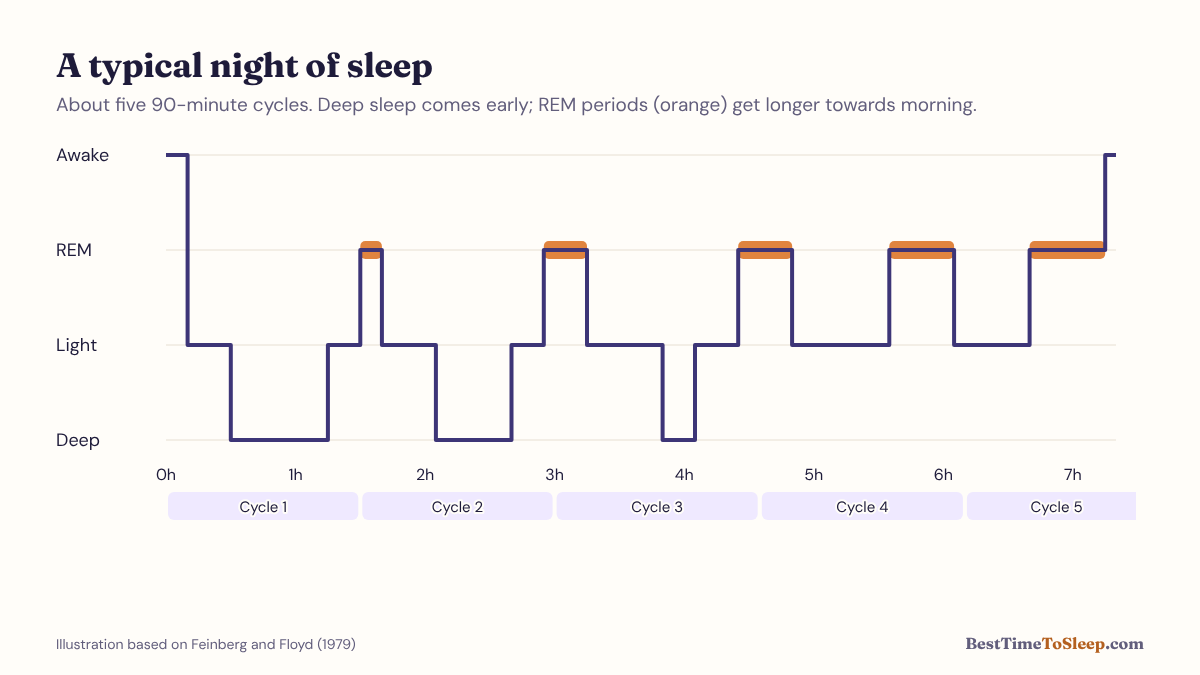
An adult sleep cycle lasts about 90 minutes on average, but a normal cycle can be anywhere from about 70 to 110 minutes. Most people go through 4 to 6 cycles a night. Each cycle moves from light sleep into deep sleep and then into REM sleep, when most dreaming happens, before the next one begins.
Key facts
- An adult sleep cycle averages about 90 minutes, with a normal range of roughly 70 to 110 minutes.
- A full night has 4 to 6 cycles. 7.5 hours of sleep is about 5 cycles.
- Deep sleep is concentrated in the first half of the night. REM periods get longer towards morning.
- The first REM period usually starts about 90 minutes after you fall asleep.
The four stages of sleep
Sleep scientists divide sleep into non-REM sleep, which has three stages (N1, N2 and N3), and REM (rapid eye movement) sleep. You move through them in order, and then the cycle repeats.
| Stage | Type | What happens | Share of the night (adults) |
|---|---|---|---|
| N1 | Light sleep | The drift from waking into sleep. Breathing and heart rate slow, muscles relax and may twitch. Lasts only a few minutes. | About 5% |
| N2 | Light sleep | Heart rate and breathing slow further, body temperature drops and eye movements stop. You spend more time here than in any other stage. | About 45–55% |
| N3 | Deep sleep | Also called slow-wave sleep. Heart rate and breathing are at their lowest and it’s hard to wake you. Important for feeling refreshed. | About 15–25% |
| REM | Dreaming sleep | Eyes move quickly behind closed lids, breathing becomes irregular and the brain is almost as active as when awake. Arm and leg muscles are temporarily paralysed so you don’t act out dreams. | About 20–25% |
The percentages are typical for healthy adults and change with age. According to the US National Institute of Neurological Disorders and Stroke (NINDS), people spend less time in REM sleep as they get older.
How the cycles change through the night
Cycles are not all the same. In the first cycles of the night, a large part of each cycle is deep N3 sleep and the REM period is short, often just a few minutes. As the night goes on, deep sleep shrinks and REM periods get longer, so the last cycles before morning are mostly light N2 sleep and REM.
That pattern was described in classic sleep laboratory work, including a 1979 study by Feinberg and Floyd, which also found that the middle cycles of the night tend to be longer than the first and last ones.
This has a practical consequence: if you cut your night short, you mostly lose REM sleep, because so much of it comes in the final hours.
Why waking at the end of a cycle feels better
Being woken from deep sleep can leave you groggy and slow for a while, a state called sleep inertia. Waking from light sleep or at the end of a REM period usually feels easier.
That’s the idea behind our sleep calculator: it counts back from your wake-up time in whole 90-minute cycles, then adds the time you take to fall asleep. For a 6:30 AM alarm, that means going to bed at about 10:45 PM (5 cycles) or 9:15 PM (6 cycles).
It’s a guide rather than an exact science, because:
- Cycle length varies from person to person, and from one cycle to the next in the same night.
- Stress, alcohol, noise and an unfamiliar bed all change your sleep pattern.
- Children have shorter cycles: about 50 to 60 minutes in infants, getting longer as they grow.
If you regularly wake up a few minutes before your alarm feeling alert, your timing is probably about right. If not, try moving your bedtime 15 minutes earlier or later, or set a different cycle length in the calculator’s settings.
How many cycles do you need?
| Cycles | Sleep | Who it suits |
|---|---|---|
| 4 | 6 hours | Below the 7-hour minimum for adults. Fine occasionally, not every night. |
| 5 | 7.5 hours | Most adults |
| 6 | 9 hours | Teenagers, and adults who need more sleep |
The American Academy of Sleep Medicine recommends at least 7 hours a night for adults, 8 to 10 for teenagers and 9 to 12 for children aged 6 to 12. See the full chart in how much sleep do I need?
Sources
- National Institute of Neurological Disorders and Stroke: Brain basics: understanding sleep
- Feinberg I, Floyd TC. Systematic trends across the night in human sleep cycles. Psychophysiology, 1979
- Watson NF et al. Recommended amount of sleep for a healthy adult. AASM and Sleep Research Society, 2015
Frequently asked questions
How long is one sleep cycle?
About 90 minutes on average in adults, with a normal range of about 70 to 110 minutes.
How many sleep cycles are in 8 hours?
About 5, since 5 cycles of 90 minutes take 7.5 hours, plus the time it takes to fall asleep.
Is it better to sleep 6 hours or 7.5 hours?
7.5 hours. Both are whole cycles, but 6 hours is below the 7 hours adults are advised to get.
Which sleep stage is the most important?
All of them. Deep sleep helps you feel physically restored, and REM sleep is important for memory and mood. Getting enough total sleep is the best way to get enough of each.